
Shell Gas Safety Tips
Your safety comes first with every Shell Gas cylinder.
Your Guide to Safe Cooking.
Your Guide to Safe Cooking.
- Check rubber tubes regularly for cracks
- Before use, cover the full length of the nozzle for both the cooker & gas cylinder with the gas tube.
- If you place the cylinder in a cupboard, there should be ventilation openings both at the floor level and at the top level.
- Do not keep your gas cylinder exposed to the sun, rain, dust, and heat.
- Do not place the appliance directly in front of the window. There is a chance that a strong breeze may put off the flame causing a gas leak.
- Always strike your match stick before you open the burner knob of your gas cooker.
- Use cotton clothes or an apron while cooking with gas. Never use synthetic clothes like Nylon that can easily catch fire.
- Always keep your cylinder in an upright position. Never sideways or upside down.
- Do not have curtains on the windows near the gas stove.
- Ensure that you have switched off the regulator every night before going to bed or before heading away on a holiday.
- Always ventilate your gas cylinder storage area.
- Check the rubber hose to ensure it is not worn out, cracked, or expired. Ensure you get your rubber hose changed at least every two years.
- Do not allow children to play near the gas cylinder.
- For any queries on all the above reach us on:
Swapping Your Cylinder? Here’s How to Do It Safely
Swapping Your Cylinder? Here’s How to Do It Safely
- Put out all the flames and fires in the kitchen/room.
- Close all the taps on the burner.
- Turn the switch knob of the regulator from the “ON” position to the “OFF” position.
- Grip the regulator and pull the bush (Black plastic locking ring) up and lift the regulator by giving a gentle swivel. The regulator will thus get detached from the valve.
- Place the safety cap on top of the valve. Press down the cap firmly until you hear a distinct click. Now the empty cylinder can be removed.
Tips to Stretch Your Shell Gas
Tips to Stretch Your Shell Gas
- Wipe utensils dry before placing them on the burner. This saves you gas needed to evaporate the excess water.
- Before commencing the actual cooking, prepare and collect all ingredients that you require to prepare the meal.
- Chop vegetables and keep spices ready at hand to avoid wasting time once the flame is lit up.
- Thaw frozen food before cooking to save the heat energy that would be required to bring down the food’s temperature.
- Once you sufficiently heat up the cookware, put the burner on medium or slow mode. The amount of heat required to cook is much less than what is needed to heat up the cookware to the desired temperature at the beginning. In addition, food cooked on low heat has better nutritional value.
- Avoid open pot cooking as much as possible. With the lid on the pot, you save energy more efficiently.
- Where possible, cook using a pressure cooker as it consumes less time and energy.
- Do not use too much water while cooking as the evaporation of the excess water will mean more consumption of gas.
- Be sure, Be safe, use Shell Gas.
Emergency Advice: Suspected Leak/Actual Leak
Emergency Advice: Suspected Leak/Actual Leak
What to do:
- Extinguish all naked flames and ignition sources.
- Turn off all gas appliances.
- If the leak is indoors, open doors and windows to increase ventilation.
- If safe to do so, move the cylinder outdoors to an open space away from people, buildings, drains and sources of ignition.
What not to do:
- Don’t switch any electrical equipment on or off.
- Don’t turn on the gas supply until it has been made safe to do so by a competent person.
- Don’t dispose of cylinders in domestic or industrial waste facilities.
- To avoid damage, which might result in a gas escape or personal injury, handle cylinders carefully, don’t drop them or roll them on their side. Store and use cylinders in an upright position.
Emergency Advice: Fire
Emergency Advice: Fire
What to do:
- Call the Fire Emergency Services immediately and inform them LPG cylinders are on the premises.
- Turn off the gas supply if it is practicable and safe to do so.
- Remove cylinder/s from the vicinity of the fire if safe to do so.
- In the case of a gas fire, stop the source of the gas leakage before extinguishing the fire, if it is safe to do so. If the leakage cannot be stopped, consider allowing the fire to continue to burn until the source can be isolated.
What not to do:
- Don’t approach cylinders in the vicinity of the fire if it’s not safe to do so.
- Do not turn on the gas supply until it has been made safe to do so by a competent person.
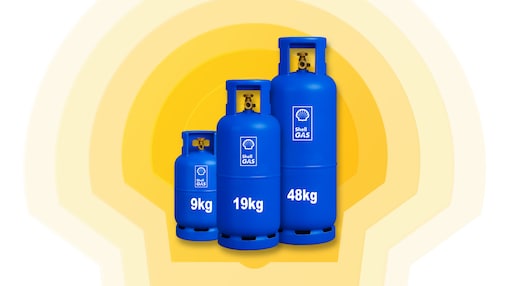
Dear Shell Gas Customer
Welcome to your official guide for Shell Gas safety. This page is designed to give you 24/7 access to essential tips and best practices, ensuring that Shell Gas remains a reliable and safe partner in your kitchen. At Vivo Energy Namibia, we are committed to the highest safety standards.
Shell Gas is a clean, efficient, and safe product. We take every precaution to ensure that you and your family can cook with total peace of mind.
Enjoy your cooking experience with Shell Gas.
Shell Gas. Safe for you and your family.
Our Commitment
With Shell Gas, we are committed to:
- Pursuing the goal of no harm to people.
- Protecting the environment.
- Using material and energy efficiently to provide our products and services.
- Developing energy resources, products and services consistent with these aims.
- Openly sharing information on our Health, Safety, Security, and Environment performance.
- Playing a leading role in promoting best practice in our industry.
- Managing Health, Safety, Security and Environment matters as any other critical business activity.
- Promoting a culture in which all our employees share this commitment.
Marks of Safety for Shell Gas
- A valid cylinder
- A safety warning notice
- The distinct Shell Gas Logo
- Net KG content mark/weight
Important Dates
- Your cylinder is due for revalidation every 10 years.
- Hose validity: to be replaced every five years.
To reach this commitment, Vivo Energy Namibia (the custodian and supplier of Shell Gas):
- Has a systematic approach to Health, Safety, Security, and Environment management designed to ensure compliance with the law and to achieve continuous performance improvement.
- Pursues its activities to protect its customers, employees, and the public from associated health hazards.
- Promotes safety awareness, believes all injuries are preventable and promotes individual accountability for accident prevention.
- Conducts thorough investigations into Health, Safety, Security and Environment incidents and near misses with significant actual or potential consequences, and reports accordingly.
- Requires contractors to manage Health, Safety, Security, and the Environment in line with this policy.